
If it’s been a while since your last dental checkup, you might wonder:
“Do I really need X-rays every year?” or “Are dental X-rays still safe?”
These are two of the most common questions we hear in Weymouth, MA — and the good news is: modern dental X-rays are safer, faster, and more precise than ever before.
Here’s what’s changed, why they’re important, and how your dentist protects you during every step.
1. Why dentists take X-rays
Dental X-rays (also called radiographs) help us see what the naked eye can’t — inside, between, and beneath your teeth.
Even with perfect brushing, small problems can hide under the surface.
X-rays allow your dentist to:
- Detect cavities forming between teeth
- Find infections or abscesses before they cause pain
- Check bone health around your gums
- Track developing teeth in children and teens
- Evaluate wisdom teeth, implants, and jaw structure
Without them, early problems could stay hidden until they’re painful or expensive to fix.
2. Modern X-rays use extremely low radiation
In the past, film X-rays required higher doses of radiation to get clear images.
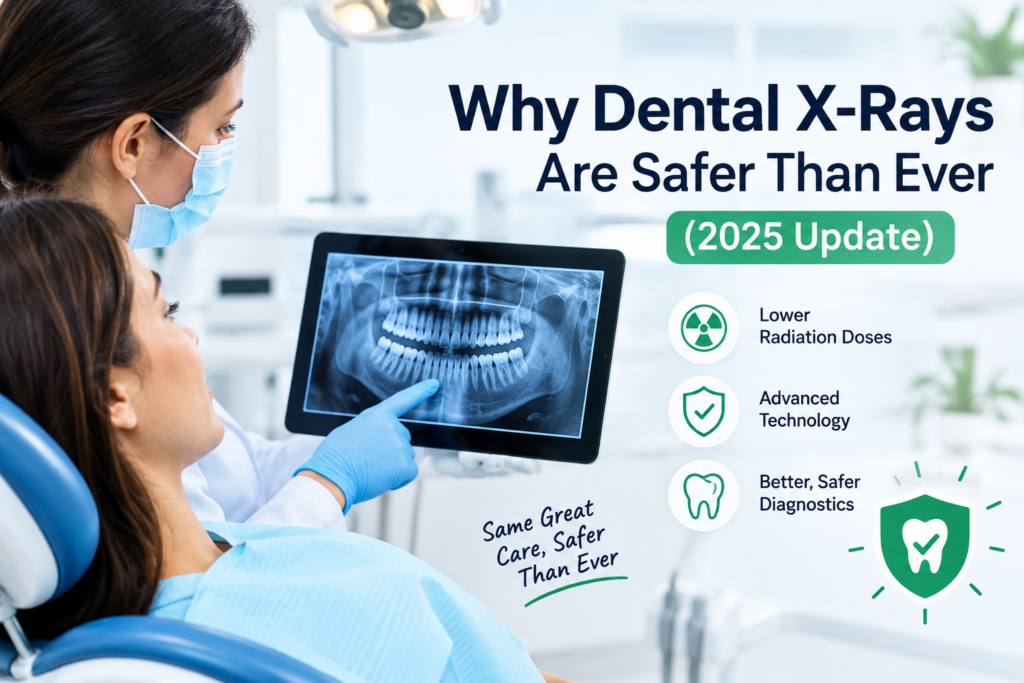
Today’s digital X-rays use up to 90% less radiation and produce instant, detailed images.
To put this in perspective:
- A full set of dental X-rays exposes you to less radiation than a short plane flight from Boston to Chicago.
- You receive more natural background radiation from sunlight in a single day than from a dental visit.
Digital systems are also safer for the environment — no film, no chemicals, no waste.
3. Types of dental X-rays
Different X-rays serve different purposes:
- Bitewing X-rays: show the top and bottom teeth together; used to detect cavities between teeth.
- Periapical X-rays: show the whole tooth, from crown to root tip.
- Panoramic X-rays: provide a full view of your mouth and jaw, perfect for wisdom teeth and orthodontics.
- 3D Cone Beam (CBCT): advanced imaging used for implants and surgical planning.
Your dentist will only take the images necessary for your unique situation.
4. Safety standards are higher than ever
Even with low-radiation technology, we still follow strict safety steps:
- Lead aprons and thyroid collars for every patient
- Digital sensors that require the shortest exposure time possible
- Regular equipment calibration for accuracy and safety
We use the ALARA principle — “As Low As Reasonably Achievable” — to ensure every exposure is minimal and medically justified.
5. Are X-rays safe for kids and pregnant patients?
Yes — with proper precautions.
For children:
X-rays are critical for monitoring tooth development and catching cavities early. We use child-size sensors and the lowest exposure settings possible.
For pregnant patients:
Routine X-rays are often postponed unless absolutely necessary. In urgent cases, double-shielding completely protects both you and your baby.
Modern research shows no measurable risk from dental X-rays when taken properly.
6. Why skipping X-rays can be risky
Without X-rays, cavities between teeth or infections under fillings can go unnoticed until they’re severe.
By the time something hurts, treatment may require a root canal or extraction instead of a simple filling.
Preventive imaging helps us catch problems early, keeping treatment minimal, affordable, and comfortable.
7. Bottom line
Dental X-rays are one of the safest and most valuable tools in modern dentistry.
They provide:
- Early problem detection
- Clear, instant imaging
- Minimal radiation
- Greater accuracy and peace of mind
At our Weymouth, MA dental practice, we use the latest digital technology to keep your care as safe and effective as possible.
So next time we say, “Let’s take a quick X-ray,” you can relax — it’s one of the simplest, safest ways to protect your smile.